

There is a question that sounds simple but actually opens up thousands of years of history: when did people first realize that if you throw a rice grain into hot sand, something magical happens?
The grain sits there for a second. Then pop. It bursts open and expands into something three, four, or five times its original size. It becomes lighter, crunchier, and sweeter in aroma. It transforms from something you have to cook into something you can eat right now, with nothing else at all.
That moment of discovery somewhere in the ancient riverbanks of Bengal, long before anyone had a name for what they were making, is the beginning of the entire story of Khoi, Muri, Chire, and all the traditional South Asian rice snacks that followed.
This blog is about that story. Where did these snacks come from? How they were made. What they meant to the people who ate them. And why, despite centuries of change, colonization, famines, and modernization, do they still sit at the center of Bengali food culture today?
Where It All Began: 4,000 Years of Rice in Bengal
To understand rice snacks, you first have to understand what rice means to Bengal. Not just as food, but as identity, as currency, as devotion, and as survival.
Domesticated rice cultivation in the Bengal region began about 4,000 years ago. The grain came from Southeast Asia, traveled westward, found the fertile delta of Bengal carved by the Ganges, the Brahmaputra, and hundreds of smaller rivers, and never left.
Over these four millennia, the farmers of Bengal did not just grow one type of rice. They grew hundreds. Ancient farmers created thousands of rice varieties, each adapted to local land and climatic conditions, a process which Charles Darwin called “artificial selection” by early cultivators. Different villages grew different strains for different purposes. Some rice was for daily boiling. Some was for festivals. Some varieties were specifically suited to making beaten rice (Chire). Others popped best into Khoi. Others puffed most crisply into Muri.
In Bengal, to inquire after someone’s well-being, you ask “bhath kheyecho?” literally, “have you eaten rice?” If you have, it is assumed you must be well. This is not just a saying. It reflects the reality that for most of Bengal’s history, rice was the difference between life and death. A government report from the 1940s showed that a large section of the Bengali population received almost 3,500 of their daily 3,600 required calories from rice itself.
But boiled rice has one big limitation: it has to be prepared. It needs water, fire, and time. In a land where farmers worked long hours, where pilgrims traveled great distances, where soldiers camped for weeks, something lighter and more portable was needed. That is where the ancient art of puffing and popping rice began.
Khoi: The Oldest Rice Snack in Bengal
Before Muri. Before Jhal Muri. Before any of the street foods we know today, there was Khoi.
Khoi is popped rice, and it is important to understand that this makes it different from puffed rice (Muri). The distinction is real and specific.
Both Khoi and Muri are rice by-products, but they are different in flavor and texture. While Muri is puffed rice, a bit harder and crispier, Khoi is popped rice, light and fluffy like popcorn. The key difference lies in what goes into the process: Khoi is made from unhusked rice grains, meaning the entire paddy with the hull still intact, while Muri is made from husked, parboiled rice that has already been processed.
When a paddy grain with its husk is thrown into very hot sand, the heat builds up inside, and the grain literally explodes through its own outer shell, blossoming outward. The result looks, and in many ways behaves, exactly like popcorn irregular, puffy, soft on the inside, and attached to its now-empty husk. The husk has to be removed by hand afterward, which is why traditional Khoi-making was a slow, careful, and skilled process.
Khoi or Popped Rice is traditionally made from unhusked rice grains by hot sand frying. The individual husks, after being popped, need to be removed manually. The aroma and flavor, combined with this painstaking task, make it one of the premium products of Bengal.
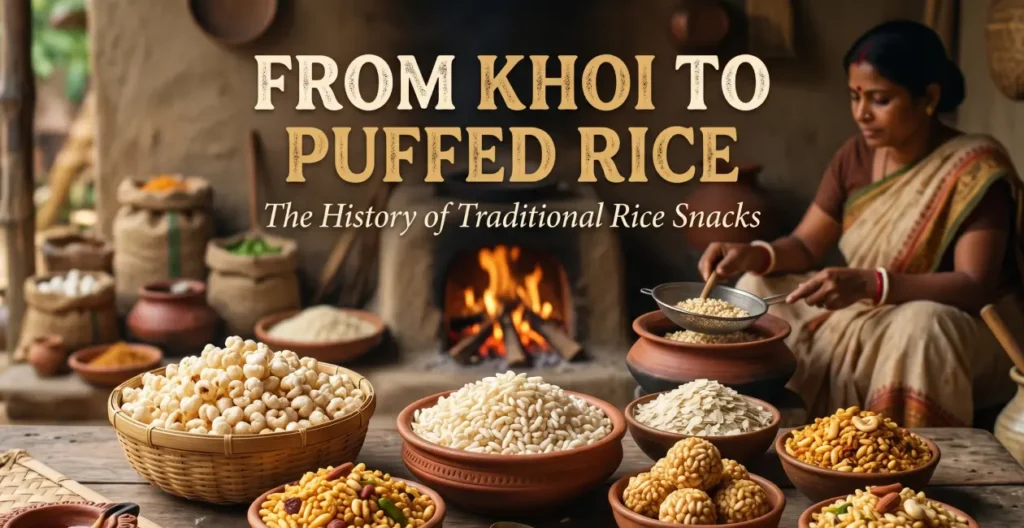
Here is the image that captures it best from collective memory across Bengal: a clay oven in a village courtyard. Dry sand heating in a big iron wok. A grandmother holding a small handful of paddy grains above her head. She drops them in. A few seconds of silence. Then — a series of tiny white explosions, like white blossoms opening all at once. And that slow, patient work of separating each Khoi from its empty husk afterward.
Khoi in Ancient Bengali Literature
Khoi is not just a snack from recent memory. It appears in Bengali texts that are hundreds of years old.
In another episode of the Chandimangal, a celebrated work of Bengali literature compiled by poet Mukundaram Chakravarti in the 16th century, detailed descriptions of Bengali dishes include Khoi (a kind of puffed rice), sugar, and curd made with buffalo milk among the general ceremonial food items of the time. This single mention tells us that Khoi was already a well-established, respected food by the 16th century, associated with ceremony and celebration.
Even earlier, the first Bengali texts of the 11th century, the Charyapadas, describe rice as a foundational crop of the region. While these texts do not mention snack forms specifically, they set the stage for a civilization built entirely around rice, where turning it into portable, lasting forms would have been a natural and ancient practice.
By the 17th century, the Khoi appear in the Kamalammangal, a renowned Bengali religious text written by poet Krishnaram Das. In his poetic vision, he selected the golden grains of the Kanakchur rice variety to create an ornament for the foot of Goddess Kamala (Lakshmi, the goddess of rice). The connection between Khoi and the divine was already deeply written into Bengali culture.
Khoi and the Sacred: A Snack for the Gods
One of the most remarkable things about the Khoi is their spiritual life. This is not a snack that stays on the plate. It belongs on the altar.
Khoi and Murki Khoi are bound with jaggery into sweet balls that serve as prasad (sacred offering) during Janmashtami, Saraswati Puja, and Lakshmi Puja. Various Khoi-based sweet treats like Khoier Murki, Upra, and Khoier Naru (laddu) are prepared as an offering during Kojagori Lakshmi Puja, worshipping Goddess Lakshmi on the full moon night of the Bengali month of Ashwin.
Beaten, crisp, and popped rice, known as Chire, Muri, and Khoi respectively, are essential in many Bengali ceremonies. Rice is an infant’s first ceremonial solid food and the last offering to recently departed souls. It is central to ritual foods offered to deities during festivals, and an integral part of many Bengali wedding rituals.
Why Khoi specifically? Because its purity is visual and immediate. A grain of rice, puffed and bleached white by fire, with nothing added, no oil, no seasoning, no preparation beyond the heat itself, is about as close to elemental food as you can get. It felt right to offer something so simple and so transformed to the divine.
The Specific Rice Varieties Made for Khoi
This is where the story becomes beautifully specific and also where it becomes a story of loss.
Bengal’s ancient farmers did not just grow “rice.” They grew hundreds of distinct varieties, each with a specific job. The Binni variety of glutinous rice was traditionally considered one of the finest for making Khoi. The Kanakchur variety, grown in the Jaynagar area of South 24 Parganas district, was legendary for a specific reason: it retained its mild, sweet aroma even after being popped at very high temperatures.
This aromatic poppy from Kanakchur rice, when mixed with date palm jaggery (khejur gur) in winter, creates a delicacy known as Joynagarer Moa, one of the most celebrated sweets in all of Bengali cuisine. Joynagarer Moa is available only in winter, has a soft texture and mouth-melting character, and earned a Geographical Indication (GI) tag in 2012, the same kind of protected designation that covers French Champagne or Italian Parmigiano.
But after the 1960s, farmers began replacing the low-yielding Kanakchur variety with high-yielding modern strains, leading to its near extinction. Dishonest traders started using cheap synthetic aromas to mimic the unique fragrance of the original grain. Fortunately, in 1997, rice conservator Debal Deb distributed seeds of the surviving Kanakchur strain to several farmers, reviving the variety and preserving the beloved winter sweet.
This story of a snack depending on a specific rice, that rice nearly disappearing, and community effort bringing it back, shows how fragile and how precious this heritage really is.
Muri: The Democratic Snack of Bengal
If Khoi is the ancient, sacred, village-born ancestor, then Muri (puffed rice) is the younger sibling who went to the city and became famous.
The difference starts in the making. While Khoi uses unhusked paddy grains and relies on each grain exploding through its own hull, Muri starts with rice that has already been husked, parboiled, and dried. The parboiled rice is soaked in a brine solution, dried again, and then thrown into a pan of preheated salt or sand. The gelatinized starch inside expands rapidly when hit by high heat, puffing the grain to several times its size.
Muri is to rice as popcorn is to corn. But the metaphor only goes so far. Muri does not explode outward with the same dramatic burst as popcorn. Instead, it expands in a more controlled way, retaining the shape of the rice grain but becoming dramatically lighter and crispier. The result is uniformly white, uniform in size, and satisfyingly crunchy, qualities that made it ideal for street food.
By the 1800s, Muri was being sold by street vendors in the major cities of Kolkata and Dhaka. Special terracotta stoves were developed specifically for Muri-making, featuring a narrow neck to allow only one or two kernels to pass through at a time for even heating. This attention to craft produced a consistently high-quality product that could be sold cheaply, bought by anyone, and eaten anywhere.
Muri became what one might call a democratic snack. It transcended the class divisions that defined so much of colonial Bengali society. The scholar and the street sweeper, the shopkeeper and the student, all of them reached for Muri.
Chire: The Third Pillar of Bengal’s Rice Snack Heritage
Alongside Khoi and Muri stands Chire, beaten rice, also called Poha in Hindi. While Khoi pops and Muri puffs, Chire is made differently: rice is parboiled, then pressed flat and dried into thin, flat flakes.
A traditional breakfast in Bengal comprised rice in puffed form (Muri), in beaten form (Chire), or in fried form (Khoi). All three were present on every Bengali table, each with its distinct texture and its own set of uses.
Chire does not crunch in the same way. It soaks up liquid beautifully, softens quickly, and works in both sweet and savory preparations. Mixed with yogurt and a mashed banana, it becomes a complete and deeply nourishing breakfast. Mixed with mustard oil, green chili, and onion, it becomes a quick savory snack. During festivals, Chire is soaked in milk and offered as prasad during Annaprasan, the first rice-feeding ceremony for babies, mentioned in the Chandimangal as far back as 1773.
Specifically, the beaten rice (Chireh) of the Sali rice variety was so prized that it appears in an old Bengali nursery rhyme describing a grand feast: the tale of Shib, a marine trader treated by his parents-in-law to the beaten rice of Sali, the puffed rice (Khoi) of the Binni variety, the Sabri banana, and a famous yogurt from Kagmari. That rhyme preserved not just flavors but the names of the specific rice varieties that produced the finest results a kind of agricultural knowledge encoded in poetry, passed from grandmother to grandchild across generations.
The Science of Puffing: What Actually Happens Inside the Grain
Let us take a moment to understand the actual science, because it is fascinating, and it helps explain why traditional makers took such care with their methods.
Rice kernels contain a small amount of moisture inside their starchy interior. When that moisture is heated rapidly, it turns to steam. The steam builds up pressure inside the grain. Because the grain’s outer structure cannot hold that pressure indefinitely, the steam forces its way through, expanding the starch in the process.
Puffed rice is formed by the reaction of both starch and moisture when heated within the shell of the grain. The starch at the center gelatinizes and becomes airy when the water vaporizes. The result is a grain that has expanded to several times its original size, with a porous, air-filled interior that feels light in your hand and crunchy on your tongue.
In Khoi, the hull is still on the grain during this process, which means the explosion has to break through a harder outer layer, creating a more irregular, popcorn-like shape. In Muri, the hull has been removed, the grain has been parboiled to gelatinize the starch, and the puffing happens in a more controlled way through the exposed outer surface of the grain.
Traditional makers understood this intuitively without the vocabulary of science. They knew exactly how hot the sand needed to be. They knew the difference in timing between different rice varieties. They knew which paddy grain would produce a large, airy Muri and which would collapse into a flat, chewy disappointment. This knowledge, accumulated and passed down over centuries, was as precise as any modern food science.
A Nationalist Food: Muri in the Colonial Era
Perhaps the most surprising chapter in the history of traditional rice snacks is political.
In 1938, Prafulla Chandra Roy, a famous Bengali scientist and nationalist leader, wrote an essay titled “Chira, Muri, Khoi o Biscuit” (Beaten Rice, Puffed Rice, Popped Rice, and Biscuit) published in the journal Bharatbarsha. His argument was clear and data-driven: the Indian puffed rice and beaten rice are more nutritious and cheaper than biscuits. He presented a table of nutritional values showing that vitamin content is higher in Muri and Chire than in biscuits, where the percentage of vitamins is very low.
This was not just a food argument. It was a cultural and political one. As British goods, including mass-produced biscuits from British companies, flooded Indian markets under colonial rule, people like Prafulla Chandra Roy pushed back. They argued that traditional Indian foods were not primitive or inferior. They were nutritious, affordable, rooted in centuries of agricultural wisdom, and worth choosing over imported alternatives.
This debate, between traditional rice snacks and Western biscuits, went on through the middle of the 20th century. In the end, both coexisted. Bengali pantries made room for both the tin of biscuits and the clay pot of Muri. But the nationalist argument left a mark. It gave these humble snacks a dignity and a political identity they had not previously been given in official discourse.
From Clay Ovens to Jhal Muri Carts: The Evolution Continues
The most dramatic evolution in the story of Bengali rice snacks happened in the streets of Kolkata.
Muri had always been a portable food. But it was in colonial-era Kolkata that Muri got a companion, spices, oil, vegetables, lemon, and became the street food we know as Jhal Muri. As Bihari migrants arrived in Kolkata in large numbers during World War II, they brought with them their own tradition of mixing and seasoning puffed rice with pungent mustard oil. What emerged from the combination of Bengali Muri and Bihari seasoning technique was Jhal Muri, arguably the most popular street snack in the history of the Bengali-speaking world.
From that cart on a Kolkata street corner, Jhal Muri spread to railway platforms, to school gates, to park benches, to the beaches of the Bay of Bengal. It traveled to Bangladesh, where it became just as embedded in daily life. It traveled to London, where British chef Angus Denoon sold it from a van called the Everybody Love Love Jhal Muri Express. It traveled to New York City through the Bangladeshi diaspora.
All of that movement began with a single, ancient discovery: a grain of paddy dropped into hot sand, blossoming white.
The Three Brothers: A Quick Comparison of Khoi, Muri, and Chire
| Feature | Khoi (Popped Rice) | Muri (Puffed Rice) | Chire (Beaten Rice) |
|---|---|---|---|
| Starting grain | Unhusked paddy | Husked, parboiled rice | Parboiled rice |
| Method | Hot sand, hull still on | Hot salt or sand, hull removed | Pressed flat, then dried |
| Texture | Fluffy, irregular, like popcorn | Crispy, uniform, light | Flat, soft, absorbs liquid |
| Primary use | Prasad, Murki sweets, with milk | Jhal Muri, Moa, breakfast | Soaked with yogurt, savory dishes |
| Sacred significance | Very high- Lakshmi Puja, Janmashtami | Moderate, everyday and festival | Present- Annaprasan ceremony |
| Rice varieties | Binni, Kanakchur | Kelas, Dahar Nagra, Nalpai | Ajirman, Chandrakanta, Manik Kalma |
What We Are Losing and What Is Being Saved
The story of traditional rice snacks is also, unfortunately, a story of things disappearing.
While Chire, Muri, and Khoi continue to flourish in Bengal’s cuisine, many of the unique rice varieties used to prepare them have either disappeared or are on the verge of extinction. Today, activists and farmers are working to restore the region’s biodiversity through seed banks and grassroots movements.
The Vrihi rice seed bank, founded by Dr. Debal Deb, has collected 576 rice varieties, perhaps the final number of varieties that were in cultivation in Bengal up until 2012. Many have already disappeared from farms.
What does this mean for the snacks? When a specific rice variety disappears, so does the particular flavor, aroma, and texture that only that variety could produce. The popped rice (Khoi) of Kanakchur from the Jaynagar area of southern Bengal used to be in demand specifically because it retained a mild aroma even after popping. When farmers stopped growing Kanakchur, and dishonest traders started selling fake versions made from modern cultivars, the real Joynagarer Moa lost its essential character. It became a copy of itself.
This is why heritage rice snacks matter beyond nostalgia. They are the edible evidence of an agricultural civilization that lasted 4,000 years. Losing them means losing knowledge that took generations to build.
The Heritage Lives in Your Kitchen Today
For South Asians in the USA, these traditional rice snacks are more than comfort food. They are a thread of connection to a history that runs deeper than most of us ever stop to think about.
When you make a bowl of Jhal Muri at home, which you can learn to do step by step in our full Jhal Muri recipe guide on the DesiSlice blog, you are continuing a tradition that started in village courtyards of Bengal a thousand years ago or more.
When you give a child a handful of Muri with warm milk and a mashed banana, you are feeding them the same breakfast that Bengali grandparents have given their grandchildren for as long as anyone can remember.
When you buy a pack of Laxmi Kurmura Laddu, puffed rice balls bound with jaggery, from DesiSlice, you are eating one of the oldest sweet forms in South Asian food history. The combination of puffed rice and natural sweetener is as old as Khoi itself.
These are not old-fashioned foods. They are ancient ones, which is different. Old-fashioned things go out of date. Ancient things endure because they are built on something real: the taste of a grain transformed by heat, eaten fresh, with nothing to prove.
Explore South Asian Heritage Foods at DesiSlice
DesiSlice was built to bring this tradition to South Asian communities across the USA. Whether you are looking for pantry staples that connect you to your roots, or you want to explore South Asian food culture for the first time, the DesiSlice shop is your starting point.
Browse the full range of South Asian Groceries to stock your kitchen with authentic pantry ingredients.
Visit the Snacks category for traditional South Asian snacks, including puffed rice-based sweets, that you can order from anywhere in the USA.
Explore the Tea & Beverages collection to find the chai that belongs alongside every bowl of Muri and every handful of Khoi.
And if you want to go deeper into the world of Bengali food history and recipes, the DesiSlice Blog covers everything from the cultural roots of Chanachur and Bengali Adda culture to step-by-step guides for making Jhal Muri at home.
Free shipping is available across the USA on orders over $49.
Final Thoughts: A Grain That Carries Everything
The story of Bengali rice snacks is the story of Bengal itself. Thousands of years of farming, fermented into snacks that could travel, that could be offered to gods, that could feed a family during a famine, that could sustain a student between classes, that could become the centerpiece of the most famous street food in a city of millions.
From a single paddy grain blossoming in hot sand to the bright, crunchy bowl of Jhal Muri handed to you through the window of a Kolkata train, it is all one story. One grain. One transformation.
That story is still being told every time someone reaches into a bowl of Muri, or makes a Khoi Murki for Lakshmi Puja, or stops at a tea stall and gets a paper cone of something spicy and warm and perfect.
Keep that story going. Explore it, eat it, share it.
Frequently Asked Questions
What is the difference between Khoi and Muri?
Khoi is popped rice made from unhusked paddy grains heated in sand, with an irregular, fluffy texture similar to popcorn. Muri is puffed rice made from husked, parboiled rice that is heated in salt or sand, producing a uniform, crispier grain. Both are eaten in Bengal, but Khoi has stronger ties to religious rituals, while Muri is more dominant in everyday street food.
How old are these traditional rice snack techniques?
Rice cultivation in Bengal began about 4,000 years ago. The techniques for making Khoi and Muri are described in literary texts going back to the 16th century, and are almost certainly older than the written records. The hot-sand-frying method is specifically described as an ancient technique in food scholarship.
Why are so many traditional rice varieties disappearing?
After the 1960s, India and Bangladesh introduced high-yielding modern rice varieties to address food insecurity. While these new varieties produced more rice per hectare, they replaced hundreds of traditional varieties that had specific qualities for making Khoi, Muri, Chire, and other heritage foods. Seed banks and conservation farmers are now working to preserve what remains.
Is Khoi available in the USA?
Khoi is sometimes available at South Asian grocery stores in major US cities. DesiSlice carries puffed rice-based products, including traditional puffed rice sweets, and continually expands its South Asian pantry range. Check the DesiSlice Shop for current availability.
What is Joynagarer Moa and why is it special?
Joynagarer Moa is a winter sweet made from the Khoi of the Kanakchur rice variety, bound with date palm jaggery (khejur gur). It is produced only in the Jaynagar region of South 24 Parganas, West Bengal, and is only available in winter. It earned a Geographical Indication (GI) tag in 2012, making it one of the few Indian street sweets with international protected status.




Comments ( 0 )