

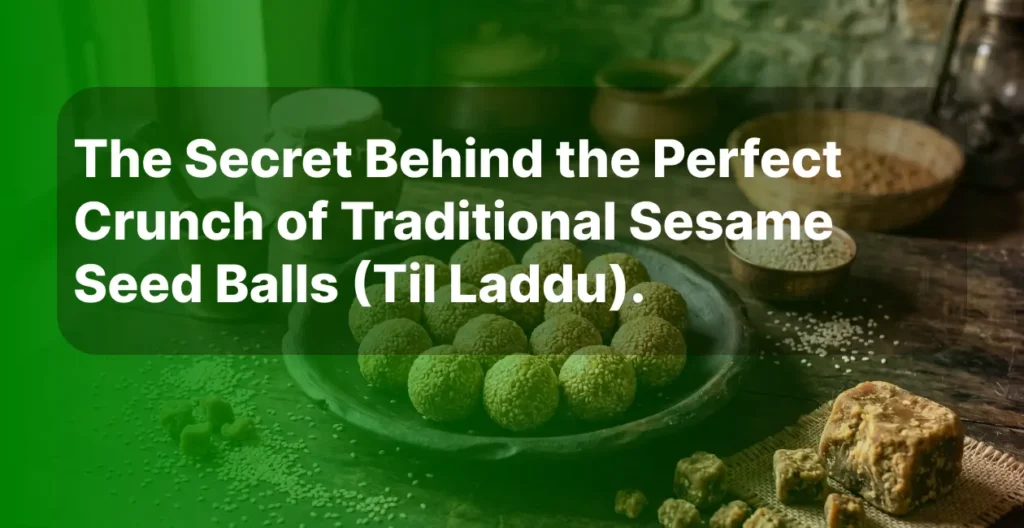
You follow the recipe exactly. You roast the sesame seeds, melt the jaggery, mix everything together, and then the balls either crumble apart the moment you shape them, or they harden into a jaw-testing brick by the next morning. Sound familiar?
The problem is almost never the ingredients. It’s the technique, specifically three variables that most recipes gloss over entirely: roasting temperature, syrup consistency, and timing. Get those three right, and your Til Laddu will have that precise snap, firm but not tooth-breaking, with a nutty aroma that fills the room the second you unwrap one.
This article walks through every step with the kind of detail that actually changes results. No vague instructions like “cook until done.” Real temperatures, real timings, and the specific signs to watch for at each stage.
What Is Til Laddu? A Quick Cultural Context
Til is the Hindi and Bengali word for sesame seeds. Laddu (or laddoo) refers to a round sweet ball, one of the oldest sweet forms in South Asian confectionery. Til Laddu sits at the intersection of both.
In Bengal, it’s called Til-er Ladoo and appears almost exclusively during the winter festival of Makar Sankranti (also called Poush Parbon), when freshly harvested sesame and jaggery flood the markets. In Maharashtra, a closely related version called Tilgul is exchanged between neighbors with the saying “Tilgul ghya, god god bola”, “Take this sweet, speak sweetly.”
In Bihar, Rajasthan, and parts of Uttar Pradesh, slightly different binding agents (peanuts, desiccated coconut, or cardamom) get mixed in. The core identity stays the same: roasted sesame seeds bound together by a jaggery or sugar syrup, shaped into balls while still warm.
This isn’t a recent food trend. Archaeological evidence places sesame cultivation in South Asia as far back as 2500 BCE. The sweet version we know today traces its documented history to at least medieval Bengal.
The Ingredients That Actually Matter
Most recipes list the same four or five items. But not all versions of those ingredients perform equally.
| Ingredient | Best Choice | Why It Matters |
|---|---|---|
| Sesame Seeds | White, hulled, fresh | Unhulled seeds turn bitter when roasted; older seeds lose oil content |
| Jaggery | Dark block jaggery (not powder) | Higher moisture content gives better syrup control |
| Cardamom | Freshly ground pods | Pre-ground cardamom loses volatile oils within weeks |
| Binding fat (optional) | Ghee (not butter or oil) | Ghee’s milk solids add flavor without excess moisture |
| Water | Minimal, only a few tablespoons | Too much water delays syrup reduction and affects crunch |
One underrated addition: A small pinch of dry ginger powder (sonth). Traditional halwais (sweet-makers) in Bengal and Rajasthan add it not for heat, but because gingerol acts as a natural preservative and deepens the overall flavor without being identifiable as “ginger.”
The Science Behind the Crunch {#the-science-behind-the-crunch}
Here is what most recipe blogs skip entirely. Understanding this changes everything.
Why Does Jaggery Syrup Determine Crunch?
Jaggery contains sucrose, glucose, fructose, and various minerals. When you heat it with water, it goes through distinct stages based on temperature:
- Thread stage (106-113°C / 223-235°F): Syrup forms a soft thread. Too soft, laddu won’t hold shape.
- Soft ball stage (113-116°C / 235-240°F): Syrup forms a soft ball in cold water. Good for some sweets, not for a crunchy laddu.
- Hard ball stage (121-130°C / 250-266°F): This is the target for crispy Til Laddu. The syrup forms a rigid ball in cold water and snaps cleanly.
- Hard crack stage (149-154°C / 300-310°F): Too far. The laddu becomes brittle and breaks rather than snapping.
Most home cooks eyeball the syrup or use the “string test,” which is imprecise. A candy thermometer eliminates the guesswork entirely and is the single biggest upgrade you can make to your Til Laddu process.
Why Does Sesame Roasting Temperature Matter?
Raw sesame seeds contain moisture. If you roast them too quickly over high heat, the outside scorches while the inside stays slightly underdone. The result: a burnt, slightly bitter taste and uneven binding because the oil distribution in the seed is inconsistent.
The correct approach is medium-low heat for 8-12 minutes, stirring continuously, until the seeds turn a pale golden color and you hear a faint popping sound. That popping is moisture escaping from the seed. Once the popping slows, the seeds are done.
Remove them immediately. Sesame seeds continue cooking on residual heat for about 90 seconds after leaving the pan. This is not an exaggeration, pull them off the heat just before they look fully done.
Step-by-Step: How to Make Crispy Sesame Seed Balls at Home
Yield: Approximately 18-20 medium laddus Active time: 25 minutes Setting time: 15-20 minutes
Ingredients
- 2 cups (300g) white hulled sesame seeds
- 1 cup (200g) block jaggery, roughly broken
- 3 tablespoons water
- 1/4 teaspoon cardamom powder (freshly ground)
- 1/8 teaspoon dry ginger powder
- 1 teaspoon ghee (for greasing hands)
- Pinch of salt
Method
Step 1: Roast the Sesame Seeds Heat a heavy-bottomed pan (cast iron or thick stainless steel works best) over medium-low flame. Add the sesame seeds in a single layer. Stir constantly with a wooden spoon or flat spatula. After 8-10 minutes, you’ll hear gentle popping and the seeds will turn pale golden. Pull them off the heat immediately. Transfer to a wide plate or tray to stop carryover cooking. Let them cool for 5 minutes.
Step 2: Prepare the Jaggery Syrup In the same pan (wiped clean), add jaggery and water. Heat over medium flame, stirring until the jaggery dissolves completely. Clip your candy thermometer to the pan. Stop stirring once it starts bubbling, stirring at this stage causes crystallization. Let it cook undisturbed until the thermometer reads 125-128°C (257-262°F).
Test: Drop a small amount into a bowl of cold water. It should form a hard ball that still has a slight give. Not soft, not completely rigid.
Step 3: Combine Working quickly, add the roasted sesame seeds, cardamom, and dry ginger to the syrup. Stir vigorously for 30-40 seconds to coat every seed. The mixture will look glossy and thick.
Step 4: Shape the Laddus Grease your palms generously with ghee. Scoop approximately 2 tablespoons of the warm mixture and roll firmly between your palms into a ball. Apply real pressure, hesitant rolling creates a loose laddu that crumbles. Work fast; the mixture sets within 8-10 minutes of leaving the heat.
Step 5: Set and Store Place shaped laddus on a parchment-lined tray. Do not refrigerate. Let them cool at room temperature for at least 20 minutes before stacking or storing. Store in an airtight container at room temperature for up to 3 weeks.
PRO TIP: If the mixture sets before you finish shaping, place the pan briefly (15-20 seconds) over low heat while stirring. This re-warms the syrup just enough to continue shaping without re-cooking it.
Regional Variations Across South Asia
Til Laddu is not one recipe. It’s a family of recipes that shift significantly depending on geography.
| Region | Local Name | Key Variation |
|---|---|---|
| West Bengal | Til-er Ladoo | Date palm jaggery (nolen gur) instead of cane jaggery |
| Maharashtra | Tilgul | Smaller size, sometimes with desiccated coconut |
| Rajasthan | Til ke Laddu | Addition of roasted peanuts and fennel seeds |
| Gujarat | Tal na Ladva | Lighter color, sugar-based syrup instead of jaggery |
| Bihar | Til Laddoo | Coarser grind, sometimes mixed with roasted chana flour |
| Punjab | Til Gachak (flat version) | Pressed into slabs rather than rolled into balls |
The Bengali version using nolen gur (date palm jaggery) is widely considered the most complex-flavored. Date palm jaggery has a caramel-molasses depth that cane jaggery simply cannot replicate. It’s also available in limited quantities outside of Bengal, typically only from specialty South Asian grocers.
Nutrition Profile: Why Til Laddu Is More Than Just a Sweet
Sesame seeds are nutritionally dense in a way that most sweets cannot claim.
Per 100g of traditional Til Laddu (approximate values):
| Nutrient | Amount | % Daily Value |
|---|---|---|
| Calories | 450-480 kcal | – |
| Protein | 11-13g | 22-26% |
| Total Fat | 28-32g | mostly unsaturated |
| Calcium | 780mg | 78% DV |
| Iron | 14mg | 78% DV |
| Magnesium | 350mg | 83% DV |
| Zinc | 7mg | 64% DV |
| Fiber | 6-8g | 24-32% DV |
Sesame seeds contain sesamin and sesamolin, two lignans with documented antioxidant properties. Jaggery contributes iron and small amounts of potassium. This is genuinely why Til Laddu was traditionally given to women post-childbirth and to workers during cold-weather harvests, it’s a high-density energy and micronutrient source wrapped in a convenient, portable form.
Eat 2-3 laddus as a snack. Not a dozen. The calorie density demands portion awareness.
PRO TIP: Til Laddu is one of the best natural sources of plant-based calcium available. A 2-laddu serving provides more calcium than a glass of cow’s milk. For vegans or lactose-intolerant individuals, this makes it a practical dietary inclusion, not just a treat.
Common Mistakes and How to Fix Them
1. Laddu won’t hold shape / crumbles when bitten Cause: Syrup didn’t reach hard ball stage. Fix: Cook syrup 5-8 degrees higher next time. Confirm with a thermometer, not just the string test.
2. Laddu is too hard / breaks teeth Cause: Syrup went past hard ball into hard crack territory, OR seeds were over-roasted and lost too much moisture. Fix: Pull syrup off heat at 126°C maximum. Roast seeds at lower heat for longer.
3. Sesame seeds taste bitter Cause: Over-roasting, or using unhulled black sesame seeds without adjusting the roasting time. Fix: Medium-low heat, constant stirring, remove from heat while still pale golden.
4. Mixture sets before shaping is complete Cause: Delaying between mixing and shaping. Fix: Have everything set up before combining, greased hands, parchment tray ready, no distractions.
5. Laddus become sticky the next day Cause: Too much moisture in the jaggery or added water, or storing in a humid environment. Fix: Use block jaggery over powdered, minimize water in the syrup, and store with a silica gel packet in the container.
Where to Buy Authentic Til Laddu Online {#where-to-buy-online}
For those who want the real thing without making it at home, here’s where to look in the USA:
- Patel Brothers Online:- Reliable for seasonal Til Laddu around Makar Sankranti (January)
- Amazon (Indian grocery sellers):- Search “Til Laddu” or “sesame brittle balls”; filter by sellers with verified review histories
- iShopIndian / MyDeshi:- Stock traditional sweets from Indian brands like Haldiram’s and Bikaji
- Local Indian sweet shops:- Mithaikaran or Indian sweet shops in cities with large South Asian communities (Edison NJ, Artesia CA, Devon Ave Chicago) often make fresh Til Laddu in January
Buying tip: When purchasing packaged Til Laddu, check for:
- Jaggery as an ingredient (not refined sugar, though sugar versions exist)
- No added vegetable oils or hydrogenated fats
- A manufacturing date within the past 4-6 weeks for freshness
Pro Tips From Traditional Sweet-Makers
These come from documented practices of Bengali and Rajasthani halwais, not generic food blogs:
The “hand temperature” test: Experienced sweet-makers can tell the syrup stage by pressing a drop between thumb and index finger and pulling apart slowly. The thread length and elasticity map to temperature. Learning this takes time, but a thermometer replicates the result without the learning curve.
Toast your cardamom whole first: Before grinding, dry-toast the whole cardamom pods in a dry pan for 60 seconds. The shells split open and release oils more readily when ground. The difference in aroma is noticeable.
Black sesame variant: Some traditional recipes use 25% black sesame seeds mixed with 75% white. Black sesame has a stronger, slightly more bitter flavor and adds visual contrast. The nutritional profile is nearly identical, with black sesame having marginally higher antioxidant levels.
The jaggery quality check: Good block jaggery should be slightly moist to the touch, dark brown, and crumble when you press hard with a knife. Pale, powdery jaggery has been processed further and behaves differently in syrups, it crystallizes more easily and can make your laddu grainy.
The Crunch Is in the Details
A perfect Til Laddu is a study in precision. The roasting, the syrup temperature, the speed of shaping, none of it is complicated, but all of it requires attention. The traditional sweet-makers who produce these by the hundreds every winter don’t have secret ingredients. They have practice, and they understand why each step matters.
Now you do too.
Have you tried making Til Laddu at home, and which region’s version do you prefer? Or do you have a family recipe with a twist that nobody else seems to use? Share it in the comments below.
FAQ
What is the difference between Til Laddu and Tilgul?
Til Laddu is a broader term used across North India and Bengal for sesame seed balls made with jaggery. Tilgul is the Marathi name for a nearly identical sweet specific to Maharashtra, traditionally exchanged during Makar Sankranti. The main difference is size, Tilgul tends to be smaller, and some Tilgul recipes include desiccated coconut.
Can I use sugar instead of jaggery?
Yes, but the result is different. White sugar produces a cleaner, more neutral-flavored syrup that sets very hard. Jaggery adds mineral complexity and a slight molasses note that defines the traditional taste. If using sugar, reduce the syrup to the same hard ball stage (121-126°C) and expect a firmer, more brittle final product.
How long does Til Laddu stay fresh?
At room temperature in an airtight container, properly made Til Laddu lasts 3-4 weeks. Refrigeration is not necessary and can actually introduce moisture that makes the laddu sticky. Avoid storing near strong-smelling foods as sesame readily absorbs odors.
Is Til Laddu gluten-free?
Traditional Til Laddu made with only sesame seeds, jaggery, cardamom, and ghee is naturally gluten-free. Commercial versions may add binding agents or flavorings that contain gluten, so check the label if you have celiac disease or gluten sensitivity.
Can diabetics eat Til Laddu?
Jaggery still contains sugar and raises blood glucose, it is not a sugar-free alternative. However, jaggery has a slightly lower glycemic index than refined white sugar (around 84 vs. 65, respectively) and contains more micronutrients. People managing blood sugar should treat Til Laddu as an occasional food in very small portions, ideally after a fiber-rich meal to blunt the blood sugar response.
Why do my sesame seeds keep sticking to each other in clumps during roasting?
This happens when the pan is too hot or the seeds are added in too thick a layer. Use a wide, heavy pan, add seeds in a layer no more than half a centimeter deep, and stir constantly. If clumping continues, the seeds may have residual moisture, spread them on a tray and dry them under a ceiling fan for 30 minutes before roasting.
What is the significance of Til Laddu in Bengali culture?
In Bengali tradition, Til-er Ladoo is inseparable from Poush Parbon (also called Makar Sankranti), celebrated in mid-January to mark the end of the harvest season. Freshly harvested winter sesame and nolen gur (date palm jaggery) both become available at this exact time of year, which is why the sweet is so closely tied to the festival. It represents gratitude for the harvest and is shared with family, neighbors, and as offerings in religious rituals.





Comments ( 0 )